Marketing Packages for Small Business That Actually Bring Leads

Introduction (what I mean when I say “packages”)
When people search for marketing packages for small business, they’re usually trying to solve one problem:
“I don’t want random marketing. I want a simple plan where I pay one amount and know what I’m getting—every month.”
And honestly… that’s fair.
A good package should feel like this:
- Clear deliverables (no vague promises)
- A simple monthly rhythm (setup → launch → improve → report)
- One main goal (leads, calls, bookings, orders, foot traffic—pick one)
A bad package feels like this:
- “We’ll post on social media and do SEO” (but no details)
- “We’ll increase your awareness” (but no numbers you can track)
- “Guaranteed results” (but they won’t explain how)

Table of contents
- What marketing packages for small business should include (the non-negotiables)
- The 3 most useful package types (and who they’re for)
- What pricing usually looks like (and what people forget to ask)
- How to choose the right package in 15 minutes (my quick test)
- Real-life examples (service business, local shop, online store)
- Red flags to avoid before you sign
- What results should be tracked (the only metrics I care about)
- FAQ
- Helpful resources (external links)
1) What marketing packages for small business should include (the non-negotiables)
Most packages talk about channels (SEO, ads, social). But the best packages start with the boring stuff that actually makes results happen.
A. Tracking setup (so you don’t waste money)
If your package doesn’t include tracking, you’re basically guessing.
At minimum, your package should include:
- Conversion tracking (forms, calls, bookings, purchases)
- A clean monthly report (not 40 pages—just the numbers that matter)
- Basic troubleshooting (“why did leads drop this week?”)
Some higher-end providers also add heatmaps and call tracking systems, which can be very useful once you’re running steady traffic.

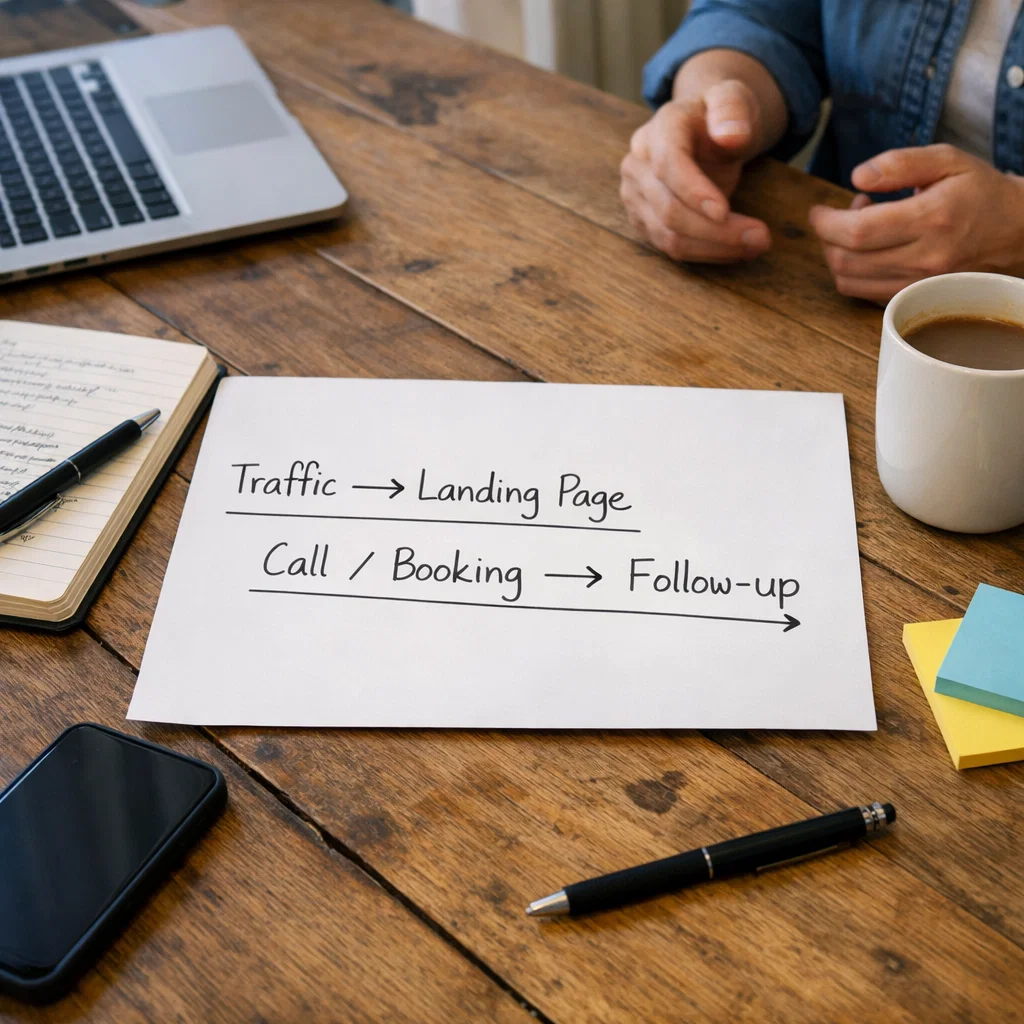
B. A landing page (or at least a “lead page”) for your main offer
Here’s a real-life tip: most small businesses don’t need a full website redesign to grow.
They need one strong page that turns visitors into leads.
That page should have:
- A clear offer (what you do + who it’s for)
- Proof (reviews, before/after, case photos, short testimonials)
- One main call-to-action (call / book / get quote)
Some packages include landing pages and funnels as part of the plan (which is great).
C. Content that matches what customers actually ask
This is where many packages feel “busy” but not helpful.
Good content answers real questions like:
- “How much does it cost?”
- “How long does it take?”
- “What’s included?”
- “What can go wrong?”
- “What do I do before I book?”
If your package includes blogs, social posts, or videos—make sure they’re built from customer questions, not “generic marketing content.”
D. A monthly improvement loop (plan → do → improve)
Marketing isn’t “set and forget.” The package should run like a routine:
- Plan: what we’re testing this month
- Do: launch content/ads/updates
- Improve: fix what’s not working
- Report: what happened + what we’re doing next
You want that steady rhythm, not random tasks.
2) The 3 most useful package types (and who they’re for)
Most businesses fit into one of these.
Type 1: Foundation Package (best for starting or restarting)
Best for: new businesses, businesses that relied on referrals, or anyone with messy marketing.
Usually includes:
- Tracking + analytics setup
- Offer + messaging cleanup
- One lead-focused landing page
- Local visibility basics (profiles, listings, reviews plan)
- Light content (like 1–2 pieces/month)
My real-life tip: If your phone isn’t ringing much right now, don’t start with “everything.” Start with foundation + one channel that brings leads fastest.
Type 2: Lead Generation Package (best for steady calls/leads)
Best for: service businesses and local businesses that want consistent inquiries.
Usually includes:
- Ads management on at least one platform
- Landing page + conversion tracking
- Lead follow-up system (email/SMS/CRM basics)
- Weekly optimization + monthly reporting
Some packaged plans list deliverables like ad management, SEO, blogs, social posting, email newsletter, and reporting in one monthly bundle.
Type 3: Growth Package (best for scaling what already works)
Best for: businesses already getting leads, ready to grow revenue.
Usually includes:
- More aggressive SEO + content plan
- Ads across more than one platform
- Email automation (nurture + win-back)
- CRO (conversion rate optimization) and testing
- Better reporting (dashboards, attribution)
Some agencies describe “starter” vs “growth” packages, plus a more SEO-focused option with dedicated monthly execution hours and reporting.
3) What pricing usually looks like (and what people forget to ask)
Pricing is all over the place because “packages” can mean very different levels of work.
You’ll see ranges like:
- Lower-cost packages starting a few hundred per month (often with an initial setup fee)
- Mid-range bundles in the low thousands per month (common for done-for-you + reporting)
- Higher-end full-service packages that can go much higher depending on scope
One broad industry breakdown puts basic packages around $500/month, with wider full-service options going far beyond that depending on scope, and many businesses landing somewhere in the middle.
The 5 questions people forget to ask (but should)
Before you sign anything, ask:
- Is ad spend included or separate?
Usually separate. If they don’t clarify, that’s a problem. - Who owns the accounts? (ads, analytics, social pages, creative)
You should. - What’s the cancellation policy?
Month-to-month vs contract matters. - How many revisions do I get?
This affects speed and quality. - What exactly counts as “content”?
One “blog post” could mean 400 words… or a full, well-researched article with images and internal links. Huge difference.
4) How to choose the right package in 15 minutes (my quick test)
If I’m choosing marketing packages for small business, I use this simple filter:
Step 1: Pick ONE main goal
Choose one:
- More calls
- More bookings
- More quote requests
- More online orders
- More store visits
If a package doesn’t ask about your goal, it’s probably a cookie-cutter bundle.
Step 2: Match the channel to your goal
Here’s the simple matching I use:
- Need leads fast? → Ads + landing page + tracking
- Want long-term steady traffic? → SEO + content + local profile
- Want repeat customers? → Email + SMS + simple CRM
- Want trust + branding? → Reviews + content + social proof + consistent visuals
Step 3: Check your “follow-up speed”
Real-life truth: many businesses lose leads because they reply too late.
If your average reply time is:
- Under 5 minutes → you’ll win more leads
- Same day → okay
- 24+ hours → you’re paying to lose leads
This is why I like packages that include CRM basics or at least a lead management flow. HubSpot, for example, positions its CRM as free and built to organize contacts, deals, and reporting in one place.
5) Real-life examples you can copy (simple and practical)
Example A: Home service business (plumber, electrician, cleaning, etc.)
Best fit: Lead Generation Package
What I’d want included:
- One high-converting “Get a quote” page
- Call tracking + form tracking
- Ads on one platform + weekly optimization
- Review plan (because trust matters)
- Monthly report: leads, cost per lead, booked jobs

Example B: Local shop (salon, gym, café, studio)
Best fit: Foundation + Growth hybrid
What I’d prioritize:
- Profile optimization + consistent photos
- Short-form content plan (simple, real, not overproduced)
- A monthly promo calendar
- Email list growth (offers, events, loyalty)
Bonus tip: Printed materials can still help local shops (cards, flyers, signage, menus, postcards). Places that sell marketing materials show how wide the category is—cards, flyers, postcards, signs, and more.
Example C: Online store (eCommerce)
Best fit: Growth Package
What I’d want included:
- Product page improvements (copy + trust + FAQs)
- Shopping/search ads + retargeting
- Email automation (abandoned cart, welcome, win-back)
- Monthly “what to improve next” roadmap
6) Red flags to avoid (learn from other people’s mistakes)
Here are the red flags I tell people to watch for:
- No tracking included (or they “can’t share reporting”)
- They report only vanity metrics (likes, impressions, “reach” with no leads)
- They won’t say what’s included in writing
- They lock you in but don’t explain how they’ll measure success
- They promise instant SEO rankings without explaining what they’ll do
Also, if they overload the package with “everything,” be careful. Too many deliverables usually means rushed work.
7) What results should be tracked (the only metrics I care about)
I keep it simple. A good monthly report should show:
Lead metrics
- Leads (calls, forms, bookings)
- Cost per lead (if running ads)
- Lead quality notes (are these real customers or junk?)
Conversion metrics
- Landing page conversion rate
- Top pages bringing leads
- Top campaigns bringing leads
Sales metrics (if you can track them)
- How many leads became customers
- Average order/job value
- Revenue influenced by marketing
And if you’re wondering about budget: one commonly cited benchmark says many small businesses allocate around 6–10% of budget to marketing.
Not as a strict rule—just as a reality check.
Frequently Asked Questions (FAQ)
1) What are marketing packages for small business?
They’re bundled marketing services (like SEO, ads, content, email, and reporting) sold as one plan—usually monthly—so you get consistent execution instead of one-off work.
2) Do I need a package or just one service?
If you only need one outcome (like “more calls”), a single service + a landing page can work. If you need consistency, tracking, and improvement month after month, a package is usually better.
3) Are cheap packages worth it?
Sometimes—if they clearly explain deliverables and include tracking. But if the package is cheap and vague, it usually means shortcuts.
4) Should ad spend be included?
Most of the time, ad spend is separate from management fees. Always ask what’s included.
5) How long until I see results?
Ads can generate leads faster. SEO and content usually take longer. Any provider should explain timelines based on your market, website, and budget.
6) What’s the biggest mistake small businesses make with packages?
Buying a package before fixing follow-up. If you don’t respond quickly, you’ll waste good leads.
7) What should I prepare before starting?
Have these ready:
- Logo, brand colors (if you have them)
- Best photos/videos you can gather
- A list of your services + prices (even ranges)
- Your top customer questions
- Access to website + profiles (or whoever has them)
8) What should be in a monthly report?
Leads, cost per lead (if ads), conversion rate, what changed this month, and what’s next. Simple and clear.
Helpful resources (external links)
- Google Search Central SEO basics (Google for Developers)
- Google Business Profile Help Center (Google Help)
- GA4 conversions/key events guidance (Google Help)
- HubSpot Free CRM overview (HubSpot)
Final note (quick advice from me to you)
If you’re stuck choosing between two marketing packages for small business, pick the one that:
- explains deliverables clearly,
- sets up tracking properly,
- and has a simple monthly improvement plan.
That’s the boring stuff that actually makes marketing work.


