6 Hour Med Tech Class Online: What It Really Teaches (and How to Pick the Right One)

If you’ve ever watched a med pass during a busy shift, you already know the truth: it’s not “just handing pills.” It’s timing, focus, documentation, resident rights, and knowing when to pause and ask questions. That’s why a 6 hour med tech class online can be such a practical step—when it’s the right type of course for your setting.
Before we go further, one quick note I always tell people: medication rules change based on where you work and who you work under. Some places allow online training for certain roles, while other places require the initial training to be taught in person and/or by specific licensed professionals.
Now let me break this down in a way that actually helps you.
What “Med Tech” means in a 6-hour online class (so you don’t enroll in the wrong thing)
When most people search 6 hour med tech class online, they mean Medication Technician / Medication Aide training—learning how to safely assist with self-administered medications (and in some settings, perform limited medication-related tasks under policy).
This is not the same as:
- lab careers (medical technologist / lab tech),
- pharmacy tech programs,
- nursing school pharmacology.
And yes—people confuse those terms all the time. You’ll even see that confusion in real discussions online.
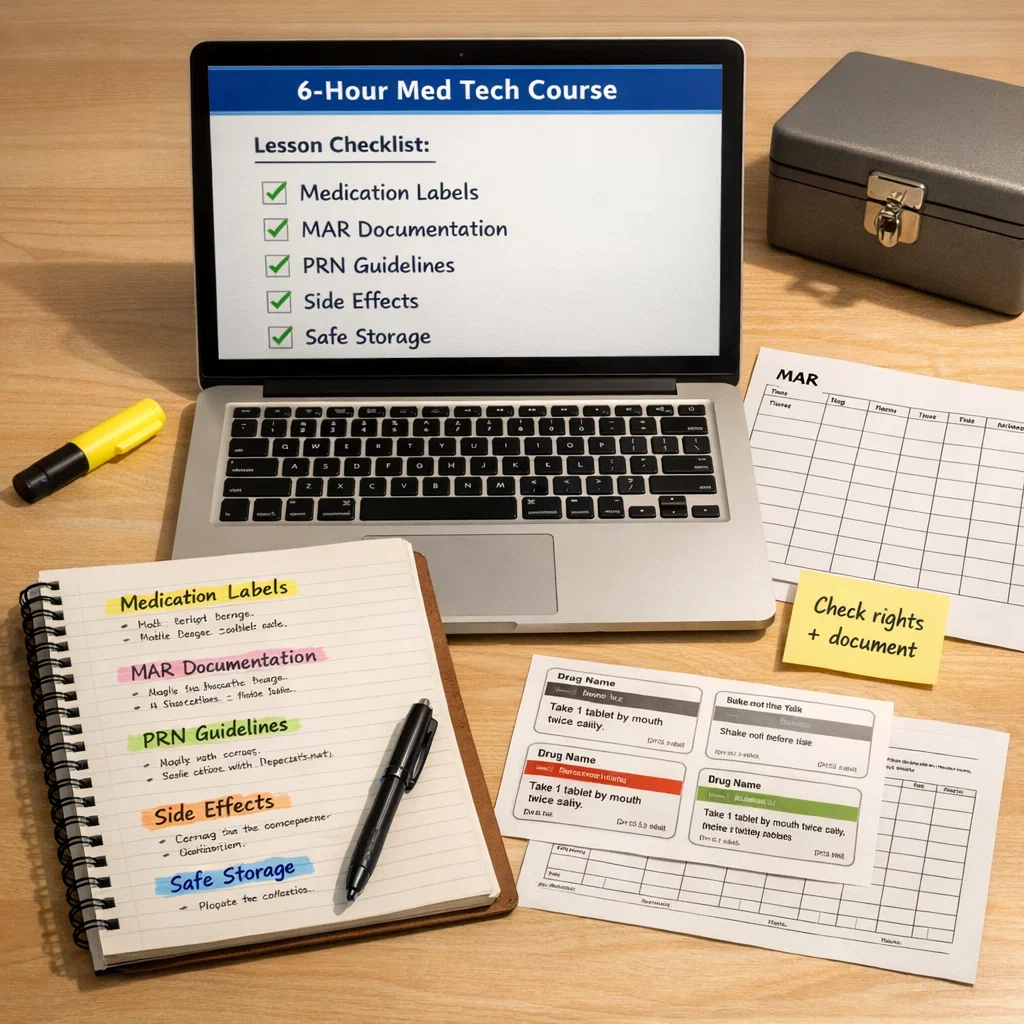
My simple rule: If your goal is to work around residents/clients and support safe medication routines, a 6 hour med tech class online is usually in that lane.
Who a 6 hour med tech class online is best for
In real life, I see these folks get the most value:
- Caregivers who want to level up and be trusted with medication support
- CNAs/HHAs/PCTs who want an extra skill that shows up in job postings
- Facility teams enrolling multiple employees and needing a consistent training baseline
- Anyone entering settings where medication assistance is a common daily task (not occasional)
If you’re already working in care, this kind of training often feels like, “Ohhh—so this is why they’re strict about the MAR.”
The acceptance check that saves you time (and money)
Here’s the part most articles skip: the certificate only matters if your employer accepts it.
Some employers accept online certificates. Some require:
- initial training to be completed in person for regulated settings
- training taught/provided by a licensed professional (commonly RN or pharmacist)
- a competency test or skills demonstration (even if the “class” is online)
My 3 questions to ask before enrolling
Use this exactly as written:
- “Do you accept a 6 hour med tech class online certificate for this role?”
- “Do you require an in-person skills check or supervised demonstration?”
- “Do you require the training to be taught/provided by a specific credential (RN/pharmacist) or approved provider?”
If they answer clearly, you’re good. If they get vague, ask: “Who signs off on med-tech competency here?”
What a quality 6 hour med tech class online should cover (the real curriculum)
A strong 6-hour class is short—but it can still be solid if it focuses on the right essentials.
Many training outlines include core topics like:
- law/rules and facility responsibility
- reading prescription labels
- giving the right meds to the right resident
- common medications and why they matter
- recognizing side effects/adverse reactions
- documentation and recordkeeping
- storage and disposal
That’s the “headline list.” What people actually need is the practical detail behind each one. So let me expand it the way I explain it on the job.

1) Prescription labels: the skill that prevents 80% of rookie mistakes
A good course should teach you to read labels slowly and literally, not “by memory.”
My label scan (simple, repeatable)
When I look at a label, I check:
- Name (and any look-alike name risks)
- Dose (strength and how much to give)
- Route (by mouth, topical, eye/ear/nose, inhaled, etc.)
- Timing (daily, twice a day, with meals, bedtime, etc.)
- Special instructions (“crush,” “do not crush,” “take with food,” “hold if…”)
- Prescriber/pharmacy notes (where your “pause and clarify” moments hide)
Some training standards specifically include skills like measuring liquids, breaking scored tablets, and crushing tablets only when directions allow it.
Real-life example:
A resident says, “I always take two.”
But the label says one. In that moment, your job isn’t to argue—it’s to follow policy: verify the order, clarify if needed, and document properly.
2) Medication routes: what you may assist with (and what you should be cautious about)
You’ll see course objectives that list common routes like oral, topical, transdermal, inhaled, eye/ear, and sometimes more.
The routes you’ll see most often
- Oral: tablets/capsules/liquids
- Topical: creams/ointments/lotions
- Transdermal: patches
- Ophthalmic/Otic/Nasal: eye/ear/nose drops/sprays
- Inhaled: inhalers, diskus-style devices (common in many settings)
Where people get shaky (and training should help)
- Eye drops (people miss the pocket and contaminate the tip)
- Patches (forgetting to remove the old one is more common than you’d think)
- Inhalers (wrong timing → “it didn’t work” complaints)
- Liquids (not shaking suspensions when required)
Quick tip I use: If a device has steps, I say the steps out loud quietly as I do them. It keeps me from skipping.
3) PRN (“as needed”) orders: the #1 place you must slow down
One common training expectation is recognizing when a PRN order is unclear and needs clarification.
When PRN becomes a problem
- No reason listed (“as needed” for what?)
- No max frequency (“how often is safe?”)
- Resident asks for it early (“it’s only been two hours…”)
- Multiple PRNs that do similar things (risk of doubling)
My rule: If the PRN directions aren’t crystal clear, I don’t “fill in the blanks.” I escalate, then document what I did.
4) Documentation and MARs: the part that protects everyone
Courses often mention learning to complete a MAR (Medication Administration Record) accurately.
What I want you to know is this: documentation is not paperwork—documentation is safety.
What “good MAR habits” look like
- Document right after you assist (not 30 minutes later)
- Use the exact codes your facility uses (taken/refused/held/missed)
- If a dose is held, document the “why” and the notification steps
- If there’s an error, follow the facility chain of reporting immediately
A small habit that makes a big difference
Before you initial/sign anything, do a 10-second recheck:
- right person
- right med
- right time
- right documentation
Even major patient-safety orgs point out that the “rights” are goals—not a full safety system—so pairing them with a repeatable process is what prevents errors.
5) Side effects & adverse reactions: what to watch for in real life
Training standards commonly include recognizing side effects/adverse reactions and what to do next.
In day-to-day care, this often looks like:
- unusual sleepiness
- dizziness or falls
- rash/itching/swelling
- nausea/vomiting
- confusion that’s new or worse
- breathing changes after inhaled meds
What matters most: noticing what’s new and taking it seriously.
6) Storage and disposal: not glamorous, but critical
Many course outlines include storage and disposal for a reason.
Disposal basics (simple and safe)
Public health agencies recommend take-back options as the best route for most unused/expired meds.
Some meds may have special disposal instructions (like specific “flush list” guidance), and environmental agencies also explain limits and context around flushing recommendations.
(Your facility will usually have its own policy—follow that first.)
How a 6 hour med tech class online typically works (modern format)
Here’s what most learners experience:
- Short modules (video + reading)
- Quick quizzes per module
- Final exam
- Digital certificate after passing
Some platforms give you a generous window to finish even though the content is “6 hours” (for example, 90 days).
Some send certificates by email during business hours, while others let you download/print immediately after passing.
If you’re curious how modern online training stays organized and trackable, I also wrote about tech and data-driven learning
The part people miss: skills validation
Even if the course is online, some employers still require hands-on competency checks (live demo, supervised pass, return demonstration).
That’s not a downside—that’s how good facilities protect residents.
What you may NOT be allowed to do (and why that’s okay)
This changes a lot by local rules and facility policy. But generally, a med tech role is often limited compared to licensed nursing roles.
You may not be allowed to:
- make clinical judgments (“increase this dose” / “skip that one”)
- administer certain high-risk meds without specific authorization
- handle IV meds
- give injections unless specifically allowed in your setting
Some training language even calls out the importance of recognizing orders that require judgment and reporting your inability to assist with those orders.
My honest take: Knowing your boundary is part of being safe, not “being less.”
My real-life med pass flow (the “I don’t skip this” routine)
If a course doesn’t teach a step-by-step routine, you’ll feel unsure on the floor. So here’s the routine I teach people to lean on.
Step 1: Set yourself up
- Wash/sanitize hands
- Quiet your space (reduce distractions as much as you can)
- Pull up the MAR/record
Step 2: One person at a time
- Identify the resident/client the way your facility requires
- Check allergies/alerts
Step 3: Prepare and verify
- Check label + MAR + timing
- Confirm route
- If it’s liquid: measure carefully
- If it’s a tablet: confirm whether it can be broken/crushed (only if ordered)
Step 4: Assist, observe, and communicate
- Explain in plain words: “This one is for ___.”
- Watch for difficulty swallowing, coughing, refusal, confusion
- For topical/eye/ear/inhaled: follow the exact technique
Step 5: Document immediately
- Record taken/refused/held/missed
- If refused: document and follow facility steps
Step 6: Wrap-up
- Store meds properly
- Report concerns early (don’t wait until end of shift)
“Is a 6-hour course even legit?” — the concern people actually have
This comes up constantly, and I get it. People have seen programs that look too cheap or too fast, and they don’t want to get burned.
In real discussions, you’ll see people pointing out that training hours vary a lot by region and setting (some mention 40 hours in their area), and they warn others to verify requirements before paying.
On the flip side, others mention getting trained quickly through a facility model.
My balanced answer
A 6 hour med tech class online can be completely valid when it matches:
- your job setting,
- your local rules,
- and your employer’s acceptance criteria.
So don’t argue with strangers online—just do the acceptance check first.
How to pick the best 6 hour med tech class online (my checklist)
If you want a course that actually helps you on the job, look for:
✅ Clear course objectives
Routes covered, MAR/documentation, storage, PRN rules, error steps, safety practices.
✅ Mentions scope and compliance
Any course that tells you to verify local requirements is being responsible.
✅ A real assessment
Quizzes + final exam—not just “watch and print.”
✅ Certificate details
Digital certificate delivery method and what information appears on it.
✅ Skills competency options (if your employer needs it)
Some programs include hands-on demonstrations/practice exercises.

A simple study plan to finish strong (without cramming)
Even though it’s “6 hours,” most people learn better when they split it.
Day 1 (2 hours): labels + routes + safety basics
Day 2 (2 hours): documentation + PRNs + common scenarios
Day 3 (2 hours): side effects + storage/disposal + final review
If your course gives you extra time to complete it (some give months), use that to your advantage—finish fast, then rewatch the parts you’ll actually use at work.
Image placement plan (exact locations + what to use)
- After the 2nd paragraph (right before “What ‘Med Tech’ means…”):
Hero image: caregiver/student at a laptop with a notebook and highlighter.
Alt text idea: “6 hour med tech class online training on laptop” - Under “What a quality 6 hour med tech class online should cover” (right before the list):
Infographic: “What’s inside a 6-hour med tech course” (labels, MAR, PRN, side effects, storage). - Under “My real-life med pass flow” (right after the heading, before Step 1):
Printable checklist image: “One person at a time” med pass checklist. - Under “How to pick the best 6 hour med tech class online” (after the checklist):
Simple comparison graphic: “Good course vs. risky course” (clear objectives, real assessment, certificate detail). - At the start of the FAQ section:
Supportive photo: student holding a printed certificate or studying with an open course module.

FAQ: 6 hour med tech class online
1) Can I finish a 6 hour med tech class online in one day?
Yes, many people can—especially if the modules are straightforward. But splitting it into 2–3 sessions helps you remember it on the floor.
2) Will my job accept a 6 hour med tech class online certificate?
It depends on your employer and local rules. Some regulated settings require initial training in person, and some require specific instructor credentials.
3) What topics should a legit course include?
At minimum: label reading, routes, PRNs, documentation/MAR, side effects/adverse reactions, storage and disposal.
4) Do online courses usually give a certificate right away?
Some email it during set hours; others let you download/print after passing.
5) Do I need hands-on skills testing if the class is online?
Some employers require it. Some courses include hands-on practice demonstrations as part of the training model.
6) Why do people argue online about how many hours med tech training should be?
Because training hour requirements vary by region and setting, and people mix up med tech roles with other careers.
7) Does a med tech role always include things like insulin pens or oxygen support?
Not always. Some training descriptions list broader task sets, but what you’re allowed to do depends on local rules and your facility policy.
Final thoughts
A 6 hour med tech class online can be a strong move when it’s aligned with your job setting and backed by real safety training. Don’t chase the fastest certificate—chase the training that makes you calm, consistent, and safe during a real med pass.
If you take only one thing from this article, take this: one person at a time, one med at a time, and document like it matters—because it does.
External resources (for deeper reading)
- Medication disposal guidance and take-back options (U.S. Food and Drug Administration)
- Context around flush-list recommendations and environmental considerations (U.S. Food and Drug Administration)
- Why the “rights” are goals—and why process matters (Institute for Healthcare Improvement)