
American Psycho Business Card Scene: A Small Office Moment That Says Everything About Power, Ego, and Fear
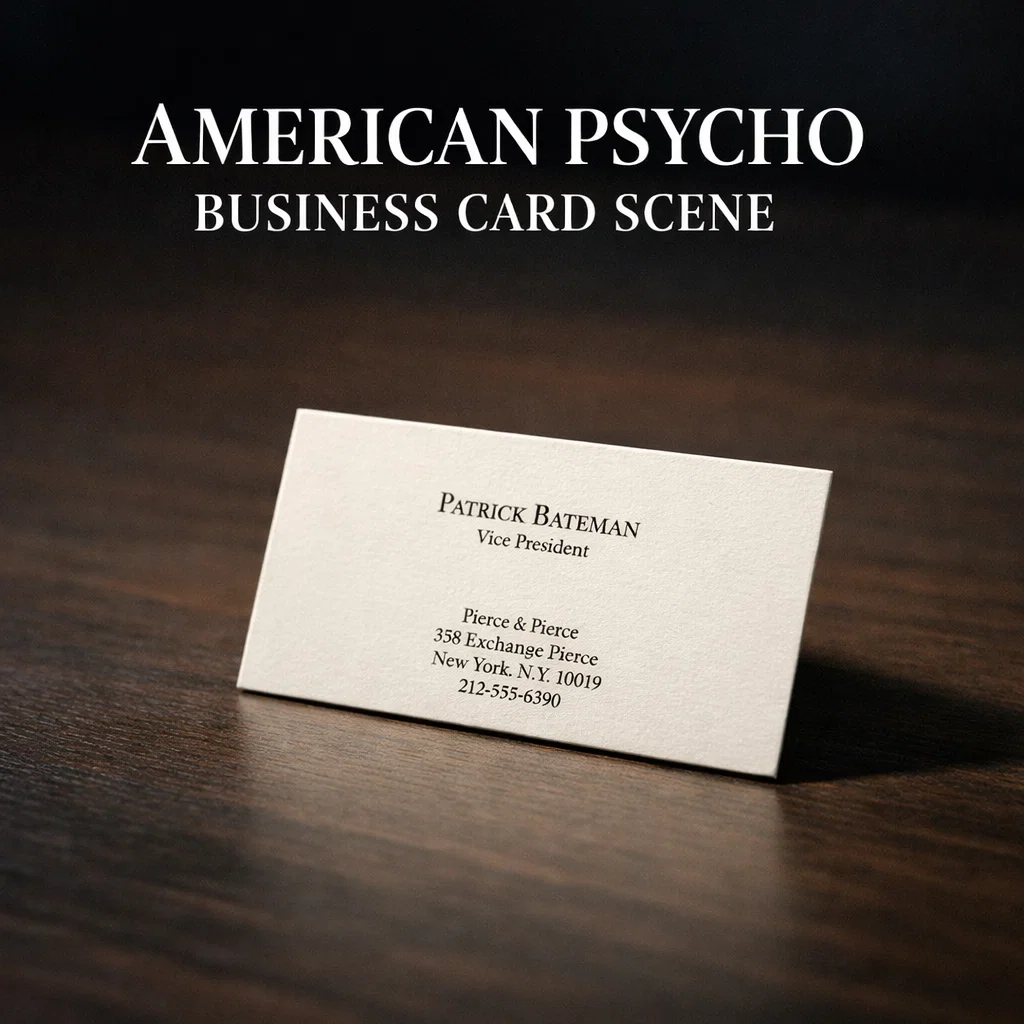
The american psycho business card scene is one of those rare movie moments where nothing big happens, yet everything is revealed.
No one gets hurt.
No one raises their voice.
No one even insults anyone directly.
And still, it feels brutal.
That’s because this scene isn’t about business cards. It’s about how adults measure worth when they don’t know who they are anymore.
Let’s break it down slowly and properly — not just what happens, but why it hits so hard, and why people still talk about the american psycho business card scene decades later.
Why the american psycho business card scene still feels uncomfortable today
Most scenes age because fashion changes or dialogue sounds dated.
This one doesn’t — because the behavior never went away.
People still:
- compare job titles
- compare brands
- compare salaries
- compare aesthetics
- pretend not to care while caring deeply
The american psycho business card scene captures that silent competition perfectly. It’s the feeling of sitting at a table where everyone is polite, but nobody is relaxed.
That tension is timeless.
What the scene is really about (in simple words)
At its core, the american psycho business card scene is about status panic.
Everyone in the room:
- dresses the same
- works the same job
- talks the same way
- wants to believe they’re special
But when everything looks identical, people start searching for microscopic differences to prove they’re winning.
That’s why a business card becomes a battlefield.
Why business cards specifically?
This is a detail many explanations skip.
A business card is:
- official
- physical
- symbolic
- meant to represent you
It’s not just contact information. It’s a tiny promise of legitimacy.
In the american psycho business card scene, the card becomes a stand-in for identity:
If my card is better, I am better.
That’s why the reactions feel so extreme.
The cards being almost identical is not accidental
Here’s the genius part.
To most viewers, the cards look the same. And that’s intentional.
Because the characters themselves are nearly interchangeable:
- same suits
- same haircuts
- same speech patterns
- same ambitions
The american psycho business card scene visually shows how shallow individuality has become in that world. They’re competing over fractions because there’s nothing else left to compete on.
Why the scene feels like a fight without violence
This scene is staged like a duel.
The “draw”
Each card reveal is treated like a weapon being unsheathed. The camera lingers. The sound sharpens. The room quiets.
The “inspection”
Each character studies the card with exaggerated seriousness, as if reading a medical report or grading an exam.
The “defeat”
When the final card appears, the reaction is not jealousy — it’s devastation.
The american psycho business card scene follows the emotional beats of a fight scene, just without punches.
Sound design: the secret weapon of the scene
One of the least talked-about details is sound.
The subtle swooshes and sharp audio cues during card reveals are not random. They give each movement weight, turning polite gestures into acts of aggression.
That’s why your body feels tension even if your brain knows it’s absurd.
Without the sound design, the american psycho business card scene would be funny.
With it, it becomes disturbing.
Editing rhythm: why it escalates so fast
The cuts in this scene get slightly quicker as it goes on.
At first:
- calm pacing
- measured reactions
Then:
- tighter shots
- faster exchanges
- heavier reactions
By the end, the emotional pressure feels unbearable — even though nothing objectively dramatic happened.
That escalation is why the american psycho business card scene feels like it’s “spinning out,” even while everyone stays seated.
Performance: controlled on the outside, chaos underneath
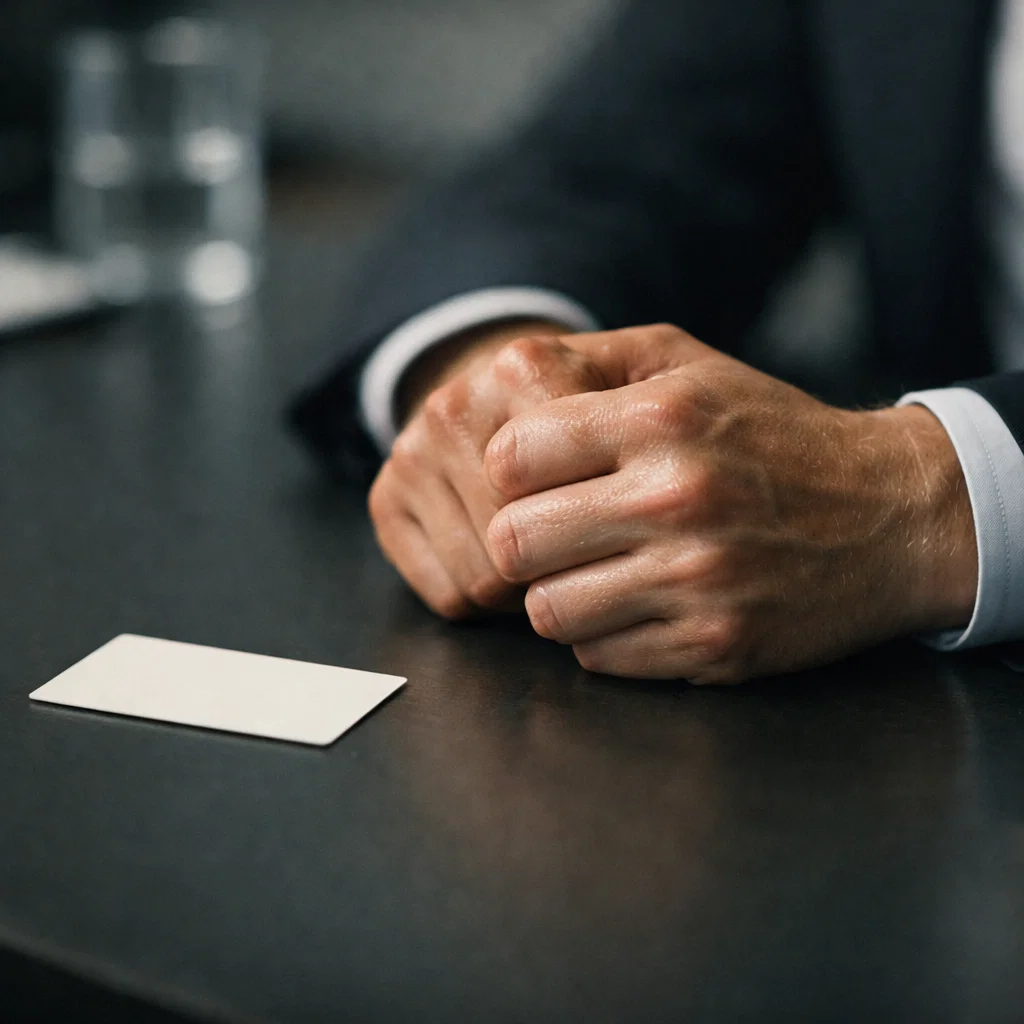
What makes the scene believable is restraint.
The main character doesn’t scream or lash out. He smiles. He nods. He pretends to admire the card.
But his body gives him away:
- stiff posture
- forced breathing
- visible sweating
- micro facial tension
That disconnect — calm words, panicked body — is the emotional core of the american psycho business card scene.
It’s how insecurity actually looks in real life.
Masculinity on display (without saying the word)
Another layer people don’t always articulate: this scene is about performative masculinity.
No one admits fear.
No one admits envy.
No one admits insecurity.
Instead, they:
- praise paper quality
- obsess over font
- talk about “taste”
The american psycho business card scene shows how emotions get rerouted into objects when men are taught not to express vulnerability.
The card becomes a socially acceptable outlet for dominance.
The “watermark” line: why it matters
The famous line about the watermark isn’t just funny — it’s revealing.
A watermark is invisible unless you know to look for it.
It represents hidden status — luxury that only “insiders” recognize.
In the american psycho business card scene, the admiration isn’t about usefulness. It’s about exclusivity.
That’s why the line hits so hard.
Why this scene became internet-immortal
The american psycho business card scene survives online because it’s endlessly adaptable.
People use it to joke about:
- comparing resumes
- comparing tech gear
- comparing followers
- comparing aesthetics
- comparing lifestyles
Any situation where tiny differences become emotionally massive fits this scene perfectly.
It’s not just a meme — it’s a template.
What the scene teaches us about modern work culture
Even today, many workplaces still reward:
- surface-level polish
- branding over substance
- appearing successful over being fulfilled
The american psycho business card scene is uncomfortable because it exaggerates a real problem instead of inventing one.
We laugh because it’s extreme.
We cringe because it’s familiar.
Real-life lessons you can actually use
Let’s make this practical.
1. People judge more quietly than you think
No one says it out loud, but details matter. Paper, presentation, clarity — they all send signals.
2. Over-polish can signal insecurity
Trying too hard often backfires. Calm confidence reads stronger than flashy perfection.
3. Minimalism works only when it’s intentional
Removing elements isn’t enough. What’s left must be precise.
The american psycho business card scene proves that subtlety only works when it’s deliberate.

If you’re inspired by the scene, here’s how to use it wisely
You don’t need to copy anything literally.
Instead, borrow the principles:
- fewer elements
- better spacing
- calm presentation
- confidence without explanation
And most importantly: don’t turn it into a performance.
The moment you try to show that you’re inspired by the american psycho business card scene, you miss the point.
Frequently Asked Questions (FAQ)
What is the american psycho business card scene really about?
It’s about status anxiety — how people use tiny symbols to measure worth when identity feels fragile.
Why does the scene feel so tense without violence?
Because it’s filmed like a duel, with sound, editing, and performance creating pressure instead of action.
Why are the business cards almost identical?
To show that the characters themselves are interchangeable, competing over microscopic differences.
Why did this scene become so popular online?
Because it perfectly represents comparison culture — something people still experience daily.
Is the scene meant to be funny or disturbing?
Both. It’s funny because it’s absurd, and disturbing because it’s recognizable.
{ “@context”: “https://schema.org”, “@type”: “FAQPage”, “mainEntity”: [ { “@type”: “Question”, “name”: “What is the american psycho business card scene about?”, “acceptedAnswer”: { “@type”: “Answer”, “text”: “The american psycho business card scene explores status anxiety, insecurity, and how people use small symbols to compete for dominance and validation.” } }, { “@type”: “Question”, “name”: “Why does the american psycho business card scene feel so tense?”, “acceptedAnswer”: { “@type”: “Answer”, “text”: “The scene uses tight framing, escalating reactions, and aggressive sound design to make a polite office moment feel like a confrontation.” } }, { “@type”: “Question”, “name”: “Why are the business cards almost identical?”, “acceptedAnswer”: { “@type”: “Answer”, “text”: “Their similarity reflects how the characters themselves are nearly interchangeable, competing over minor details to feel superior.” } } ] }
{ “@context”: “https://schema.org”, “@type”: “BlogPosting”, “headline”: “american psycho business card scene: Why This Small Moment Feels So Intense”, “description”: “A complete, human breakdown of the american psycho business card scene, exploring psychology, sound design, editing, performance, real-life lessons, and FAQs.”, “author”: { “@type”: “Person”, “name”: “Your Name” }, “publisher”: { “@type”: “Organization”, “name”: “Your Blog Name” }, “mainEntityOfPage”: { “@type”: “WebPage”, “@id”: “https://yourwebsite.com/american-psycho-business-card-scene/” }, “keywords”: [ “american psycho business card scene”, “american psycho scene analysis”, “patrick bateman business card scene”, “business card scene meaning” ] }