
Texas Business Entity Search – The Most Complete Guide You’ll Ever Need

When people talk about researching a business in Texas, the tool they’re really referring to—whether they know the name or not—is the texas business entity search. It’s one of those tools that looks simple on the surface, but once you understand it properly, you realize how powerful it actually is.
Over the years, I’ve helped many business owners, freelancers, investors, and even everyday customers look up companies in Texas. And honestly, most folks only use about 20% of what this search tool can do. So I’m breaking everything down in normal, everyday wording—the way I’d explain it if we were sitting together going through it on a laptop.
This isn’t the typical shallow article you find online. I’m giving you the deeper details, real-world use cases, and the things people wish someone had told them earlier.
Table of Contents
What Is the Texas Business Entity Search?
The texas business entity search is basically a public lookup system that lets you search for registered businesses in Texas. Every officially formed business must file certain information with the state, and that information becomes part of a public record.
Think of it like a digital library of every company—active or inactive—that has ever registered to do business in Texas.
You can find:
- Legally registered company names
- Business status (active, forfeited, inactive, etc.)
- Registered agents
- Formation dates
- Public filings and documents
- Address information
- Governing persons (when required)
- Tax standing
It’s the fastest and most reliable way to verify a company’s identity and legal existence.
Why the Texas Business Entity Search Matters (More Than People Realize)

Most people use it for basic name checks. But here’s the truth—it can help you:
- Avoid being scammed
- Avoid legal trouble when naming a business
- Make better hiring or partnership decisions
- Confirm whether a company is legitimate
- Protect yourself from fraudulent contractors or service providers
- Understand a business’s age and history
- Check compliance status before doing business
I’ve personally seen situations where someone hired a “business” that was not actually registered. When problems happened, they had nobody to legally hold accountable. A quick texas business entity search would’ve saved them thousands.
Who Actually Uses This Search Tool? (More People Than You Think)

The texas business entity search is used by:
1. New Entrepreneurs
To make sure their business name is available and legal.
2. Investors or Partners
To verify a company before putting money into it.
3. Customers
People hiring contractors, real estate companies, consultants, etc.
4. Landlords
To verify commercial tenants.
5. Sellers and Buyers
In business acquisitions.
6. Lawyers and Accountants
To check public documents and business status.
7. Business Owners
To keep track of their own filings and make sure everything is in good standing.
If you think about it, anyone who deals with a business can benefit from this search.
What You Can Find With the Texas Business Entity Search (Full Breakdown)
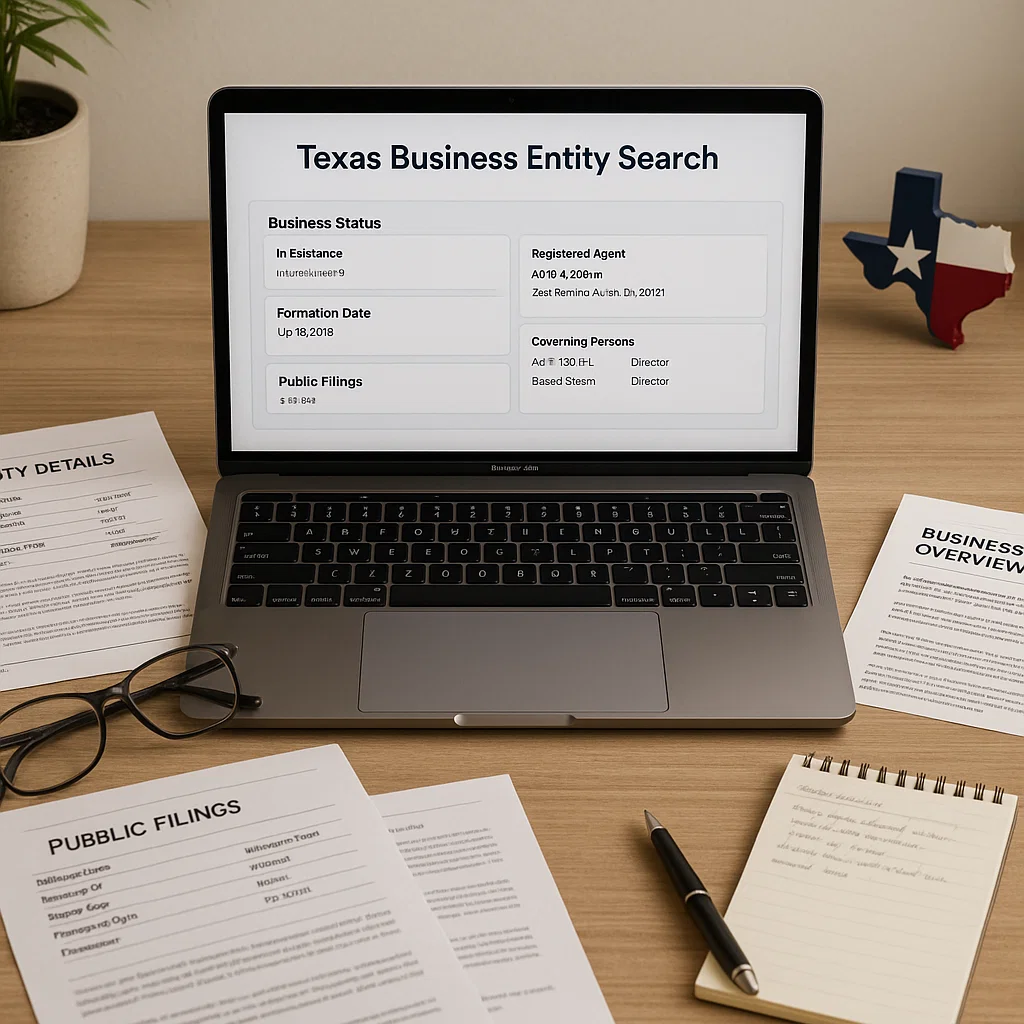
Most articles only mention 3–4 pieces of information, but in reality, you can uncover a lot more. Here’s the full list with explanations and tips for each.
1. Exact Legal Business Name
This shows the complete official name, including:
- LLC
- Inc
- LP
- PLLC
- Nonprofit
Great for confirming if the company you’re dealing with is truly registered.
Tip: A company using a name in marketing that doesn’t match the legal name isn’t necessarily bad—it may be using a DBA—but you should still verify both.
2. Entity Type
Tells you what kind of business it is.
Examples:
- LLC
- Corporation
- Nonprofit
- Professional LLC
- Foreign LLC
Knowing the type helps you understand its legal structure.
3. Business Status
This is a big one people ignore.
Statuses you may see:
- Active – Good standing
- Forfeited – Usually failed taxes or filings
- Terminated – Company voluntarily closed
- Withdrawn – Foreign company left Texas
- Not in Good Standing – Needs compliance work
A company with a forfeited status shouldn’t be operating legally. If you’re about to pay someone who has a forfeited status… pause and investigate.
4. Filing Number & Tax ID References
The filing number is like your business’s “social security number.”
Useful for requesting documents, paying taxes, or filing reports.
5. Formation Date
This tells you exactly how long the company has existed.
Real-life example:
If a business claims “20 years in business,” but their formation date was a year ago… you’ve got your answer.
6. Registered Agent
This is extremely important.
The registered agent receives legal documents, lawsuits, and state notices.
Who can be a registered agent?
- A commercial agency
- A lawyer
- A business owner
- A responsible adult in Texas
If the registered agent looks suspicious or keeps changing often, it can be a sign of instability.
7. Principal Address & Mailing Address
This tells you where the business is based or receives mail.
Tip:
If the business uses a PO Box or virtual address, that’s not necessarily bad. Many modern businesses do.
But for contractors or hands-on service providers, a real physical location is usually a good sign.
8. Governing Persons (Owners, Directors, Managers)
Depending on entity type, you may see:
- Members
- Managers
- Directors
- Officers
- Trustees
This is helpful when searching who actually runs the company.
9. Public Filed Documents
You can access:
- Formation documents
- Amendments
- Name changes
- Mergers
- Dissolution filings
- Registered agent changes
These documents can reveal ownership history or major changes in the company.
10. Franchise Tax Account Status (Through the Comptroller)
This is where you confirm whether a company is:
- In good standing
- Late on taxes
- Forfeited
- Delinquent
Many people don’t realize you can check tax standing publicly.
Comptroller search tool:
https://comptroller.texas.gov/taxes/franchise/account-status/search/
How to Use the Texas Business Entity Search (Step-by-Step Guide)
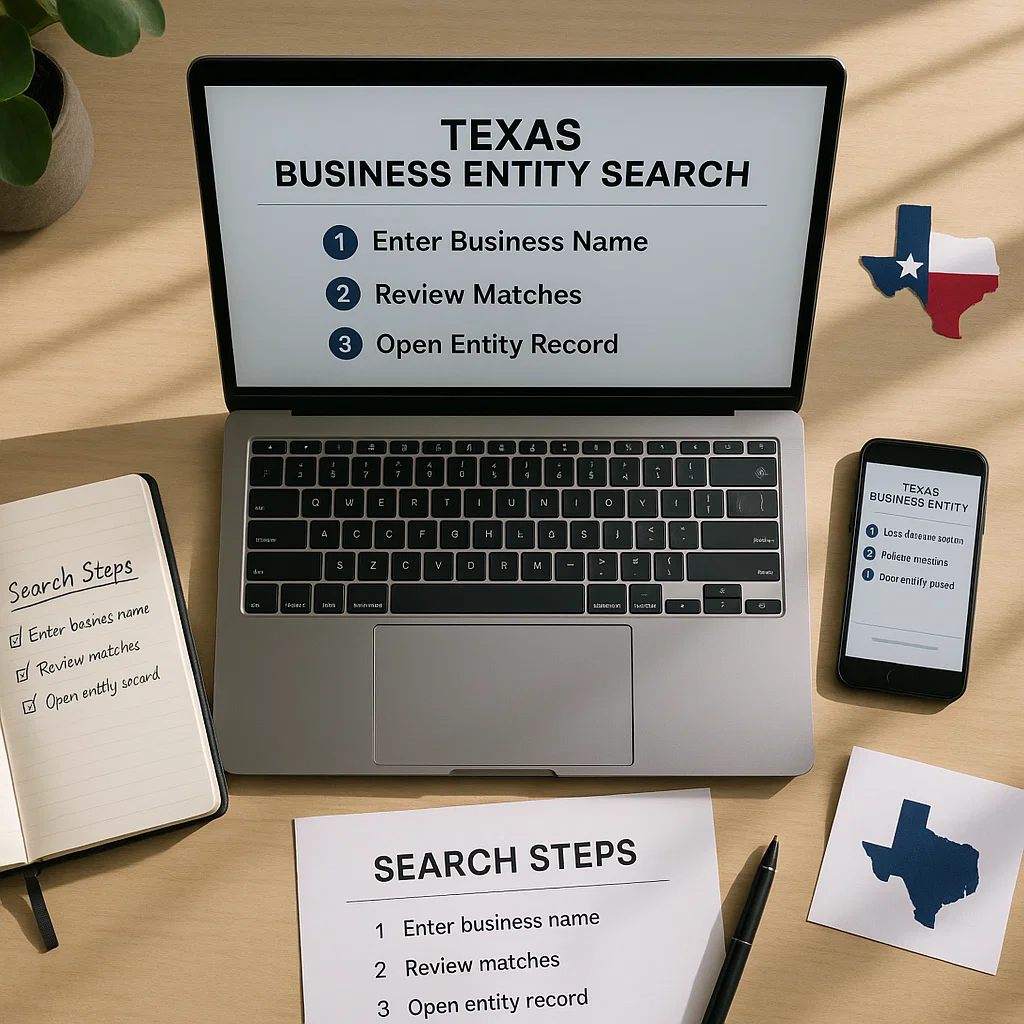
Let’s break down the actual process in simple terms.
Step 1: Visit the official search page
The main search portal is here:
https://www.sos.state.tx.us/corp/sosda/index.shtml
Step 2: Choose your search method
You can search by:
- Business name
- File number
- Tax ID
- Registered agent name
Step 3: Type your search term
If you’re checking name availability, keep it simple—don’t add LLC or punctuation yet.
Example:
Instead of “Blue Horizon Landscaping LLC,” type:
Blue Horizon Landscaping
Step 4: Review the list of matches
You will likely see:
- Exact matches
- Similar names
- Old names
- Inactive entities
This tells you whether your name is available or too close to another.
Step 5: Click into a business record
This is where all the details live.
Smart Ways to Use the Texas Business Entity Search
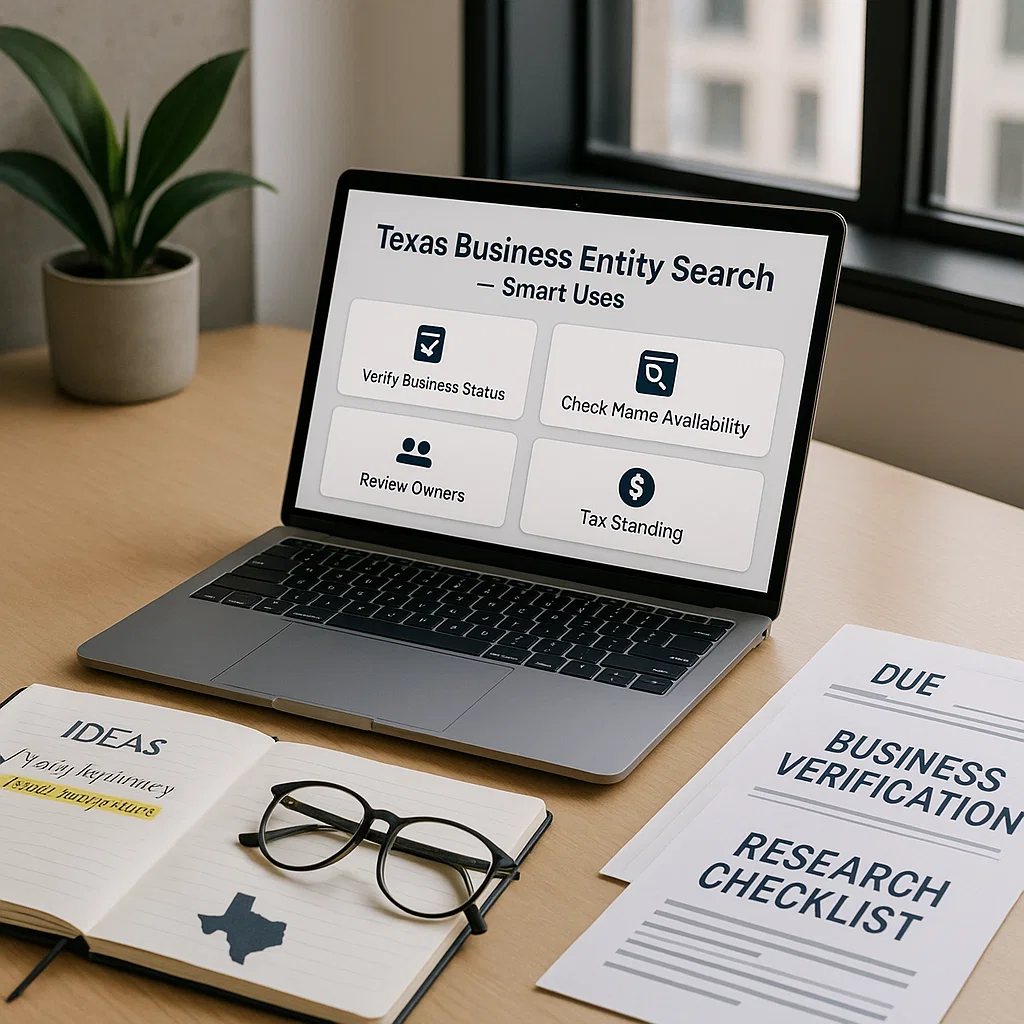
Here are practical, real-world ways people use the texas business entity search, with examples.
1. Before Hiring a Contractor
Say you’re hiring a roofing company.
I always check:
- Is the business active?
- How long have they existed?
- Does the owner’s name match the person I’m talking to?
- Is their tax status clean?
- Do they have a legitimate address?
This protects you from scams.
2. Before Filing a New Business Name
Even if your dream name seems unique, Texas may reject it if:
- It’s too similar to an existing name
- The difference is just punctuation
- It only changes “LLC” to “Inc.”
- The name could confuse customers
A thorough search avoids delays and rejection.
3. Checking If a Business Is Legit
A business card is easy to fake.
A state record is not.
4. Researching the Owners of a Company
If you want to know who runs a business, the governing persons section helps.
Example:
If you’re about to sign a partnership deal, you want to confirm the person you’re dealing with actually has authority.
5. Reporting Fraud or Suspicious Behavior
If a business claims to be licensed or registered but isn’t, you’ll know right away.
Advanced Tips Most People Never Use

Here’s where you can go deeper than the average person:
Tip 1: Use partial keywords
Searching “Texas Home Services” might miss results.
Try:
- Texas Home
- Home Services
- THS
Tip 2: Check the registered agent’s name
You may discover multiple businesses tied to the same person.
This helps you understand their business history.
Tip 3: Look at old or inactive entities
Some people reopen old companies or use dissolved ones for marketing claims.
Tip 4: Always double-check tax status
The Comptroller’s records sometimes reveal problems not shown in the Secretary of State system.
Tip 5: Compare formation date to marketing claims
If someone claims “30 years in business” but formed an LLC last year, ask questions.
External Tools That Go Hand-in-Hand with the Texas Business Entity Search
These tools complement your research:
- USPTO Trademark Search (avoid legal conflicts)
https://tmsearch.uspto.gov/ - IRS EIN Information & Guidance
https://www.irs.gov/ - Texas Comptroller Franchise Account Status
https://comptroller.texas.gov/taxes/franchise/ - Texas Taxable Entity Search
https://comptroller.texas.gov/taxes/franchise/changes.php
These help you verify everything beyond just business registration.
Frequently Asked Questions (FAQ)
1. What is the texas business entity search used for?
To look up businesses registered in Texas and view their public records.
2. Is the texas business entity search free?
Yes, searching is free. Certain documents may require a fee.
3. How do I know if a business name is available?
Search exact matches, partial matches, and check for similar names.
4. Can I find who owns a business in Texas?
Sometimes, depending on the filings and business type.
5. What does “Forfeited” mean on a business profile?
The business lost its good standing—usually for failing to file taxes.
6. What’s the difference between an LLC and a DBA?
A DBA is only a nickname.
An LLC is a legal entity with liability protection.
7. Do inactive businesses still block name usage?
Yes, in many cases an inactive name still prevents reuse.
8. How often is business information updated?
Usually quickly after filings, but not always instantly.