
Complete Guide to Oklahoma LLC Filing
When I first started looking into oklahoma llc filing, every website gave the same robotic steps—“pick a name, file your articles, pay a fee.” That’s technically correct, but it leaves out all the real questions that hit you when you’re in the middle of starting a business:
How do I pick the right structure? What paperwork matters most? What about taxes? What if I mess up? Why do banks ask for documents I’ve never even heard of?
This guide answers all of that in best way.
My goal is simple: to give you the most complete and helpful breakdown of oklahoma llc filing you’ll find anywhere.
Table of Contents
What Exactly Is “Oklahoma LLC Filing”?

When people talk about oklahoma llc filing, they’re referring to:
- Creating a Limited Liability Company under Oklahoma law
- Filing your Articles of Organization with the state
- Making your business official and separated from your personal life
Once approved, your LLC becomes a legal entity. That means:
- Your personal belongings are protected
- Your business gains credibility
- You can open business accounts
- You can hire employees
- You can sign contracts as a company
In daily life, this turns you from “someone doing business” into a recognized business owner with actual legal protection.
Why So Many Entrepreneurs Choose an LLC Instead of Other Structures

Before you start the oklahoma llc filing process, it helps to understand why an LLC is usually the go-to choice.
✔ Liability Protection
If someone sues the business, they can’t come after your home, car, or personal savings.
✔ Flexible Taxes
You can choose how you pay taxes:
- Sole proprietorship
- Partnership
- S-Corp
- C-Corp
Most new LLC owners stick with pass-through taxes at first, then switch to S-Corp when they grow.
✔ Simple Compared to Corporations
No board meetings, no corporate minutes, no complicated formalities.
✔ Professional Image
Clients take LLCs more seriously, especially larger companies.
Step-by-Step Guide to a Perfect Oklahoma LLC Filing
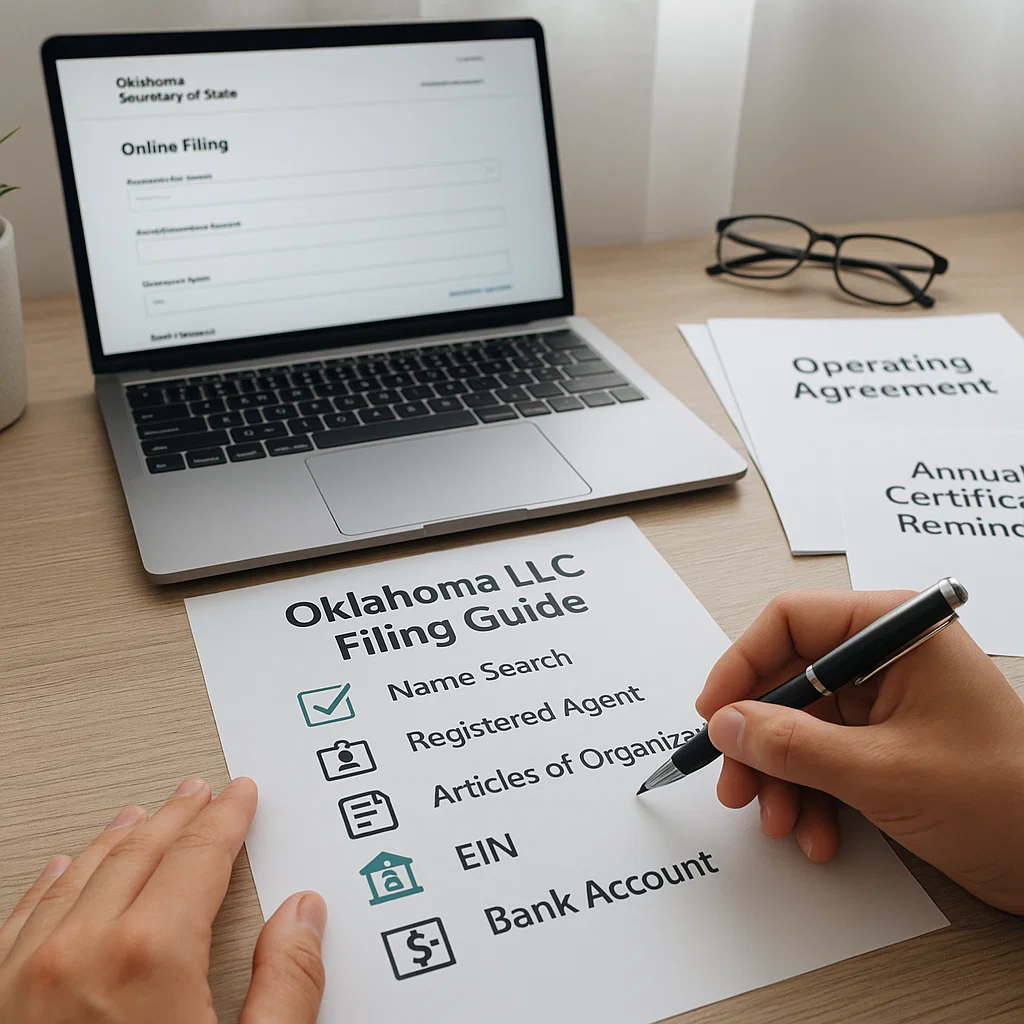
Below is the most detailed, practical, real-world breakdown you’ll find—beyond just the basics.
1. Choose a Clear, Compliant LLC Name
Your name must:
- Be distinguishable from all other businesses in the state
- End with LLC, L.L.C., or Limited Liability Company
- Not include restricted words like “bank,” “attorney,” or “university” unless you meet additional standards
Real-Life Name Selection Tips
Tip #1: Don’t pick a name that’s too clever.
If people can’t spell it or pronounce it, you’ll lose customers.
Tip #2: Check domain and social media availability.
A brand should match across platforms.
Domain search: https://domains.google
Social handle checker: https://namecheckr.com
Tip #3: Check trademarks.
A name may be allowed in Oklahoma but still violate a federal trademark.
Trademark search: https://www.uspto.gov/trademarks/search
2. Pick a Registered Agent (This Decision Affects Privacy)
A Registered Agent must have a physical Oklahoma address and be available during normal business hours.
Two Options:
A. Be Your Own Registered Agent
Pros: Free
Cons: Your home address becomes public, and you must be available for deliveries.
B. Hire a Registered Agent Service
Pros: Privacy, mail scanning, professionalism
Cons: Annual cost
If you work from home, I strongly recommend a service.
Your home address goes into permanent public records if you list yourself.
3. Prepare and File Your Articles of Organization
This is the heart of oklahoma llc filing—the official document that forms your company.
You’ll provide:
- LLC name
- Registered Agent name and address
- LLC duration (most choose “perpetual”)
- Management type (member-managed or manager-managed)
- Purpose of the business (a simple, general purpose usually works fine)
You can file:
- Online through the Secretary of State website
- By mail using the official form
New Detail Many People Miss:
If you have multiple owners, decide before filing:
- Who contributes what (money, labor, equipment)
- How profits are split
- Who can sign contracts
Once the LLC is created, changing these details becomes more complicated.
4. Create an Operating Agreement (Don’t Skip This Step)
Even though Oklahoma doesn’t legally require an Operating Agreement, you should absolutely have one.
It covers:
- Ownership percentages
- Profit distribution
- Voting rights
- Decision-making rules
- What happens if a member leaves
- How money is handled
- How disputes are resolved
Why It’s Important in Real Life
Banks often ask for it.
Partners rely on it.
It prevents misunderstandings.
It protects your “limited liability” by showing your business is structured properly.
Even single-member LLCs need it—it proves your business is separate from you.
5. Get Your EIN (Free, Fast, and Required)
Your EIN is required for:
- Taxes
- Employees
- Business bank accounts
- Setting up payroll
- Certain licenses
Apply here for free:
https://www.irs.gov/businesses/small-businesses-self-employed/apply-for-an-employer-identification-number-ein-online
Important Tip:
Do not pay any third-party website for an EIN.
The IRS provides it at no cost.
6. Open a Business Bank Account
A business account proves your LLC and personal finances are separate.
This protects your limited liability status.
What Most Business Owners Miss:
Banks may ask for:
- Articles of Organization
- EIN letter from the IRS
- Operating Agreement
- Resolution of authority (for multi-member LLCs)
Choosing a bank:
- Local banks are great for in-person support
- National banks offer advanced business features
- Online banks offer low fees and fast setup
Popular options include:
- Chase
- Capital One
- BlueVine
- Novo
- Wells Fargo
7. Understand Local Licenses, Permits & Tax Requirements
Every city and county is different. Depending on your industry, you may need:
- A general business license
- A zoning permit
- A sales tax permit
- An industry-specific professional license
- Health or safety approvals
Examples of Businesses That Usually Need Extra Licenses:
- Food businesses
- Cleaning companies
- Contractors
- Daycare providers
- Health & beauty services
- Real estate professionals
Check your local government website for specific requirements.
8. Stay Compliant by Filing Your Annual Certificate
Oklahoma requires an annual filing to keep your LLC active.
If you forget:
- Your LLC becomes “not in good standing”
- You may face penalties
- Your business can be suspended or dissolved
Pro tip:
Set two reminders—one 30 days before and one the week of the deadline.
Extra Details Most Articles Don’t Tell You

1. You Can Change Your LLC Name Later
If you pivot your brand or add services.
2. You Can Have Unlimited Owners
LLCs have no cap on number of members.
3. Foreigners Can Own an LLC
As long as the LLC has an Oklahoma Registered Agent.
4. You Can Form Multiple LLCs
Many business owners separate income streams for protection.
5. An LLC Helps With Branding
Vendors and customers often prefer working with a registered business.
Real-Life Examples to Make This Clear

Example 1: Home-Based Bakery
Sarah wants to run a home bakery. She uses a Registered Agent because she doesn’t want her home address on public filings.
She files her Articles, gets her EIN, opens a business bank account, and gets a home food license from her city.
Her LLC provides protection if someone claims food-related illness.
Example 2: Handyman Business
Mike works as a handyman and forms an LLC so customers take him more seriously.
He needs insurance and a local business license.
He uses an Operating Agreement to outline his partnership terms with his brother who helps part-time.
Example 3: Online Store Owner
Rachel runs an e-commerce store. A simple LLC protects her from customer disputes.
She doesn’t need a physical location license but does need a sales tax permit.
Common Mistakes People Make During Oklahoma LLC Filing

❌ Using their home address without realizing it becomes public
Then receiving unwanted mail or losing privacy.
❌ Forgetting to file the annual certificate
Leading to penalties or dissolution.
❌ Mixing personal and business finances
This cancels your liability protection.
❌ Missing required local licenses
Cities can fine you even if your state-level LLC is active.
❌ Not having an Operating Agreement
Banks, partners, and accountants often require it.
Frequently Asked Questions
1. How long does the Oklahoma LLC filing process take?
Online filings usually take a few business days. Mailed filings take longer.
2. How much does it cost to file an LLC?
Oklahoma charges a standard fee for Articles of Organization. Additional fees apply for Registered Agent services or optional filings.
3. Can I form an LLC without a lawyer?
Yes. Most people file themselves. A lawyer is helpful for complex partnerships or ownership structures.
4. Do I need a business plan before filing?
Not required, but having one keeps you organized and focused.
5. Can one person form an LLC?
Yes. Single-member LLCs are extremely common.
6. What happens if I don’t file my annual certificate?
Your LLC becomes inactive and may be suspended or dissolved.
7. Do I need an EIN if I have no employees?
Yes—because banks and payment processors require one.
8. Can non-residents form an LLC?
Yes, as long as the LLC has a Registered Agent in Oklahoma.
9. Do I need insurance for my LLC?
Depending on your industry, insurance may be required and is usually recommended.
10. Do I still pay taxes if I have an LLC?
Yes. An LLC changes how you pay taxes, not whether you pay them.